


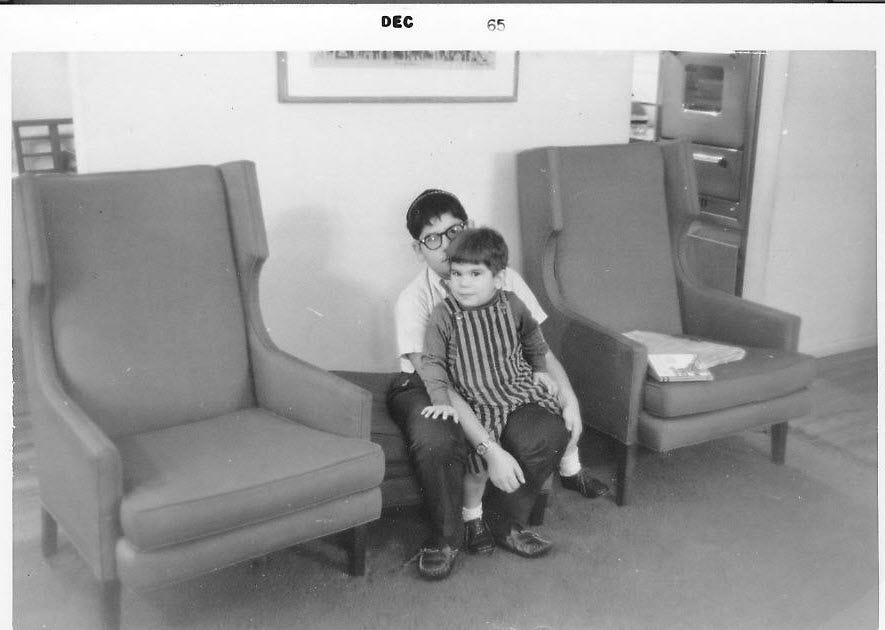
Over the years, my brother’s presence in our family grew dark. But it was not always like that.
Dear Danny,
When I was very little, you taught me that we say pregnant, not pregmant; my socks were in a drawer, not a draw. When Mom sat cross-legged on the floor she was doing yoga, not yogurt.
When I was five and you were thirteen you took me to Brighton Beach to spend a night with our grandparents. The trip, by bus, ferry, train, and then a walk in the shadow of the elevated railway, was an hour and a half each way. You took me to the beach and swam with me. When I dug in the sand, you sat on your towel and then you leaned over and gave me little kisses on my head.
When I was nine, I came home and reported that I’d won the school spelling bee. You corrected me: You mean you won for your class, just the fifth grade, not the whole school. When I managed to convince you that I was indeed the school champion, that I had even beaten the eighth graders, your face lit up. You drove me, that year and the next, to the city-wide competition in Manhattan and afterward took me to eat chicken on skewers at Yahalom on 47th Street.
You watched The Wizard of Oz with us and told us when it was safe to uncover our eyes because another scene with the Wicked Witch had ended. You explained that Dorothy and her friends fell asleep in the beautiful field of flowers because poppies are the source of opium.
You took us to classical music concerts in Silver Lake Park and animated film festivals in Clove Lake Park. Sometimes you babysat when our parents went out and, on those occasions, you baked with us. Toll House cookies from the recipe on the chocolate chip bag and bundt cake with a fluted pan.
One summer night, when I was eight and you were sixteen, you used a challah recipe from a big red book that came in the mail. I can see the three of us at the kitchen counter. Geula, in a flowered dress, brown eyes, brown hair pulled back in a braid. Concentrating on the challah strands. Me, roundish, covered in flour, reaching my fingers into the dough when I shouldn’t, smiling. And you above us in an apron, consulting the book, orchestrating, a teacher — a teenager playing school.
The recipe said to let the loaves rise in a warm, dark place, so you put them under the blanket in Geula’s bed. We tiptoed in and out of the room to check the progress.
Mom often spoke of her desire to travel, to go to Israel or France. But we all knew that we didn’t have the money for that. And even her most modest fantasy, a trip to New England, was impossible. Dad didn’t drive, and Mom, whose right leg had been crippled by polio when she was two, wore a prosthesis to the knee and tired quickly; she couldn’t drive more than an hour or so without rest.
She longed to see the trees in Vermont, the mountains in New Hampshire, and the shorelines of Cape Cod.
When you returned from your year in Israel in June 1972, you offered to make Mom’s dream come true. We were going to Cape Cod. You drove and I helped navigate with a set of TripTiks from the AAA. I will never forget that week.
At night, Mom and Dad sat in Adirondack chairs on the grass patch outside our bungalow, drinking Bloody Marys that you made for them. And they smoked — Mom a Parliament, Dad his pipe. Bees hovered and hummed in the honeysuckle that covered the hedge along the bungalow’s perimeter. The air was sweet with Dad’s pipe tobacco and the nectar of the brilliant little white and yellow flowers, and sour from the tomato juice and cigarettes. As the light dimmed, the smell of the sea and a soft mist covered us like a blanket.
In the bungalow’s kitchen we cooked with whatever we had — cans of kosher food, Hebrew National hot dogs, a dusty square electric pan you’d rescued from a shelf above the washing machine. You browned the hot dogs. I dumped in a can of Dole pineapple, juice and all. The bungalow filled with syrupy smoke. Hawaiian frankfurters.
During the days, at a nearby lake, we swam out to the floating wood docks and bathed in the sun. Now and then, you leaned over and gave me little kisses on my head.